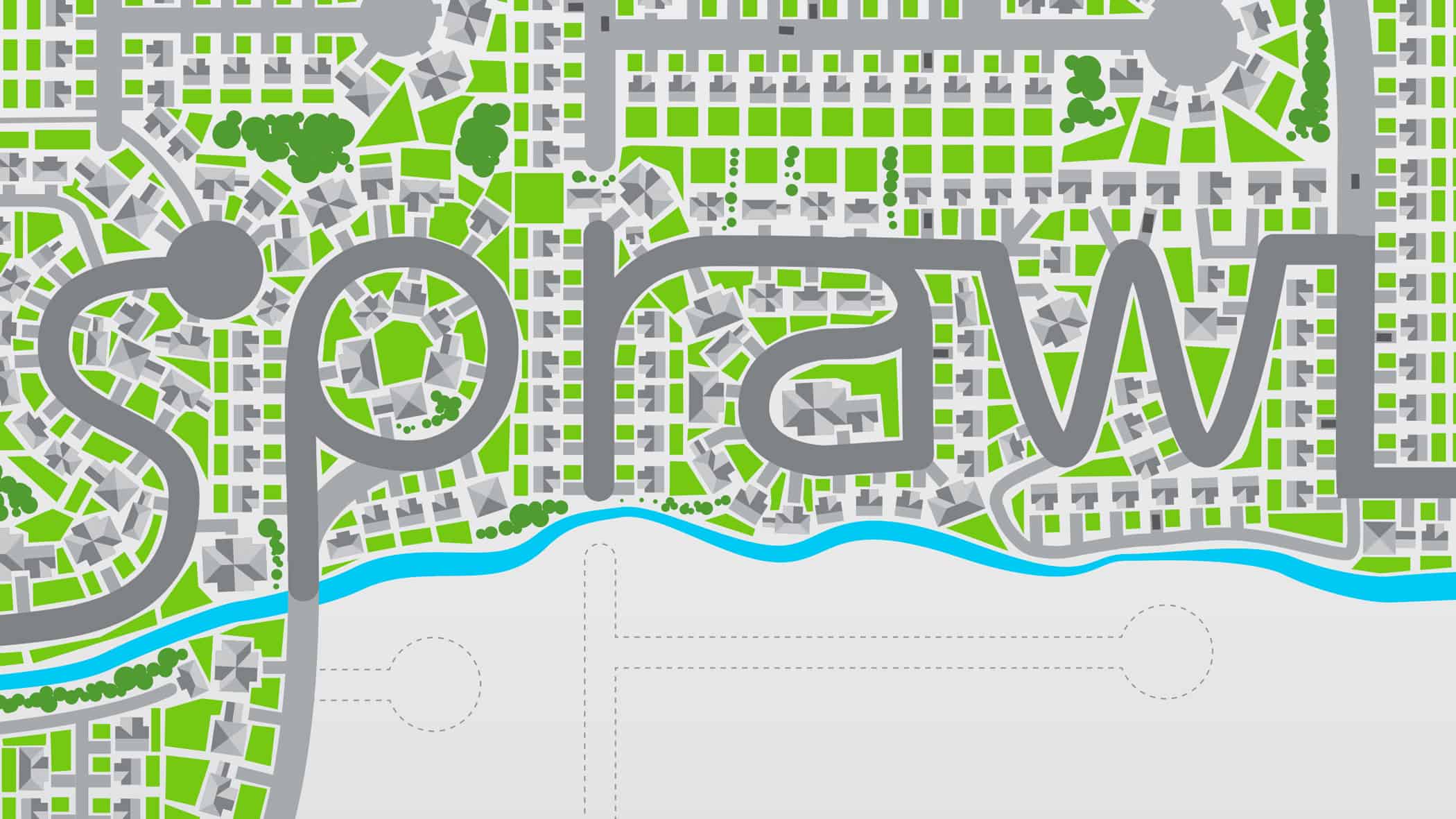
The High Costs of Sprawl

Sprawl report

The Greater Golden Horseshoe (GGH), Canada’s largest urban region, will undergo a profound change as it grows to accommodate an anticipated 4.4 million new residents by 2041, making it home to nearly 13.5 million people.

The decisions we make about how to accommodate this growth will determine what types of communities we live in, how much time we spend stuck in traffic, the quality of the air we breathe and whether our farmland and forests continue to provide us with food and habitat for our unique wildlife. There’s no question that new housing will be needed. The question is what form it will take.

Housing Supply Consultation

New housing development

The Housing Supply Consultation document appears to start from the premise, one frequently expressed by the private sector, that the housing supply issues may largely be blamed on government “red tape”, and difficulties in delivering housing as being snarled in delays and confusion. If you view the amount of development activity under way in Toronto, it is incomprehensible to state that our current progress is “too slow”. Thousands of units are currently being held up due to the LPAT transition date delay. It’s even more incomprehensible when you factor in the lack of public investment in infrastructure, transportation, schooling, community services, etc. It is utterly ridiculous to attempt to “reduce red tape” without addressing the need to increase investment in public infrastructure.

Cancellation of the Local Planning Appeal Support Centre

Nobleton development

Less than one year into its operation, the Province has announced that the Local Planning Appeal Support Centre (LPASC) is being shut.

LPASC was launched in April 2018 to help people understand and navigate the land use planning and appeal process in Ontario. The LPASC Act, 2017 mandated the establishment and administration of a cost-effective and efficient system for providing support services, and to establish criteria for determining the eligibility of persons to receive the support. The LPASC has until June 30, 2019 to wind down the business. Effective immediately, LPASC will no longer be accepting new requests for professional services from the public.

The Federation of Urban Neighbourhoods (Ontario) has sent the following letter to the Ontario Government protesting this action.

Queens Park Report – February 2019

Land use planning primer

If you or members of your organization are looking to understand how land use planning works in Ontario, the following may help. The City of Ottawa has put together a series of classes covering the basics (called Primer I and II) and specific topics, such as development charges.

While these courses were developed with Ottawa in mind, most of the content is universal. You can use the material as is, or approach your Planning Department to create classes tailored to your municipality using the Ottawa material as a base.

Urban planning primer

There is a strong provincial direction to limit urban sprawl, especially in the greater GTA, or any urban area surrounded by agricultural areas.

This forces urban centres to comply with the expectations of the Growth Plan 2017, including the determination of the designated targets for intensification and density within urban boundaries. In other words, neighbourhoods as we know them may be stable, but not static. We are seeing an increase in the number of minor variance applications.

The urban planning process can be daunting. It uses language that requires interpretation; it can involve multiple levels of review, beginning with the municipal Committee of Adjustment and possibly proceeding to a local appeal body (The Toronto Local Appeal Body for the City of Toronto and the Local Planning Appeal Committee outside of Toronto).

Queen’s Park Report February 3, 2019

If you or members of your organization are looking to understand how land use planning works in Ontario, the following may help. The City of Ottawa has put together a series of classes covering the basics (called Primer I and II) and specific topics, such as development charges.

While these courses were developed with Ottawa in mind, most of the content is universal. You can use the material as is, or approach your Planning Department to create classes tailored to your municipality using the Ottawa material as a base.

FoNTRA Letter to Ontario Government re: Bill 66

Since Bill 66, – it passed first reading on 06 December 2018 and is scheduled for second reading on 19 February 2019 – had been introduced without any public consultation, it is appropriate to comment on the underlying legislation before addressing the proposed Regulation which is to implement this new mechanism. FoNTRA sees the proposed planning tool as some sort of Trojan horse designed to undermine fundamental and carefully conceived public policies…

While FoNTRA supports the streamlining of planning approval processes and the removal of often redundant requirements and restrictions, it believes that Bill 66, as currently written, puts into question the fundamental validity of the Province’s own policy-driven planning system and signals to the world: Ontario has principles but if you don’t like them, we have others.

Queen’s Park Report – December 2018

The government’s recently introduced Bill 66 has been met with widespread concern about the threat to Ontario’s framework for environmental protection. What the Bill does (in Schedule 10) is to allow municipalities to pass “Open for Business” bylaws that give developers permission to circumvent planning and environmental legislation that includes: The Provincial Policy Statement, The Planning Act, The Clean Water Act, The Great Lakes Protection Act, The Greenbelt Act, The Oak Ridges Moraine Conservation Act, The Places to Grow Act, The Environmental Assessment Act, The Environmental Protection Act, The Nutrient Management Act, The Ontario Water Resources Act, and other less well-known legislation that was designed to protect the people of Ontario!

Queen’s Park Update – November, 2018

As reported by Environmental Defense Canada (EDC), the government has been meeting with municipalities and development industry members who have identified five challenges: Intensification and Density Targets, Major Transit Station Areas, Settlement and Boundary Expansions, Planning for Employment and Agricultural and Natural Heritage Systems.

The EDC is concerned that if the density targets are loosened in the Growth Plan, or if settlement boundary expansions are permitted (without the math to determine the land need –LNA), we can expect more sprawl and more low density growth putting increasing pressure on the Greenbelt.

EDC is also concerned that there is interest in proceeding with land swaps- trading Greenbelt land for other farmland or natural heritage land beyond the Greenbelt so lands in the Greenbelt can be developed. Even if there is no net loss of Greenbelt lands, the Plan will be eroded. The Greenbelt Plan as a provincial policy that permanently protects land will basically be kaput, signalling open season to the development industry. EDC will be developing a media strategy but needs your local voices to challenge these changes.

Smart Growth Toolkit

Smart Growth Toolkit

Environmental Defence Canada has produced a useful resource guide for citizens who want to get involved in building greener, walkable communities. The guide highlights: